We are committed to climate action, improving resource efficiency and reducing our environmental impact.
Keppel is committed to both running our business sustainably, and making sustainability our business through investing in and creating solutions that contribute to a sustainable future. This involves focusing our portfolio on sustainability-related solutions, building resilience against climate change risks, and seizing climate-related opportunities. We also minimise our impact on the environment by reducing carbon emissions, energy consumption, water consumption and waste generation, avoiding pollution and preserving biodiversity in our operations.
Keppel's climate-related disclosures are guided by the Singapore Exchange (SGX) Sustainability Reporting Guide for climate-related disclosures, including the application of the IFRS Sustainability Disclosure Standards, where relevant. Keppel also takes reference from the recommendations of the Taskforce on Nature-related Financial Disclosures (TNFD), and continues to monitor emerging regulatory requirements and international best practices regarding nature and biodiversity disclosures.
To strengthen Keppel’s resilience and mitigate against transition risks such as tougher climate legislation and higher carbon prices, Keppel has, since 2020, implemented a shadow carbon price (SCP) in the evaluation of new investments. The SCP serves as a planning tool to help us factor in the possible impact of rising carbon prices, avoid potential stranded assets, and drive investments towards low-carbon solutions.We disclose our performance in mitigating our environmental impact in our annual sustainability reports.
Keppel’s carbon reduction strategy is overseen by the Board Sustainability and Safety Committee and driven by the Management Executive Committee, which is chaired by the CEO of Keppel Ltd.
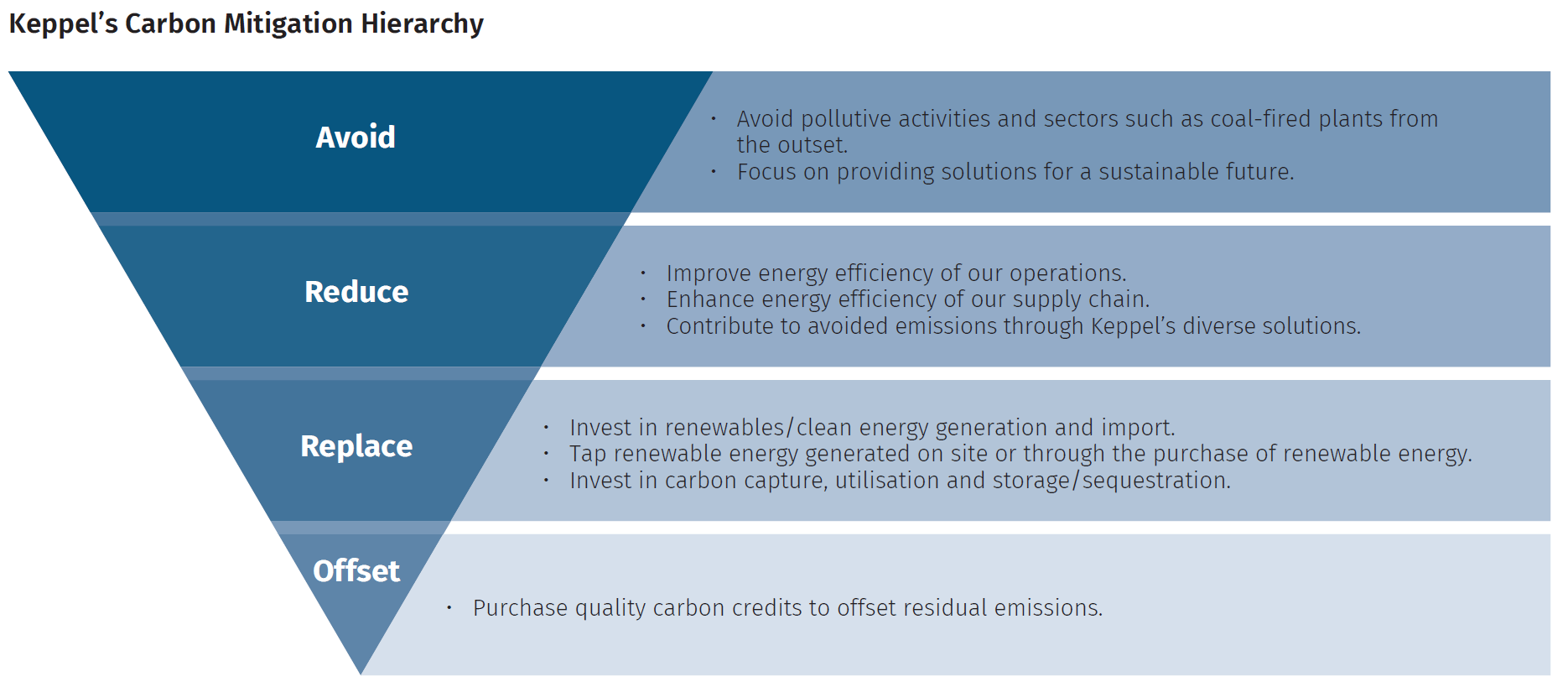
Keppel aims to halve its Scope 1 and 2 carbon emissions by 2030 compared to 2020 levels, and achieve net zero Scope 1 and 2 emissions by 2050. We plan to achieve this by focusing Keppel’s portfolio on sustainability solutions, pivoting away from more carbon intensive businesses, implementing energy efficiency measures, increasing the use of renewable energy, including through purchasing Renewable Energy Certificates, as well as purchasing carbon credits to offset any residual emissions, where necessary. The target is in line with the Paris Agreement’s goal to limit global temperature increase to 1.5°C above pre-industrial levels.
Keppel tracks all relevant categories of Scope 3 emissions. We are also working with our value chain and portfolio of investments to enhance energy efficiency and reduce their emissions where possible. Keppel’s operating divisions have set emissions reduction targets where possible, in line with their respective sectoral contexts and unique capabilities.
Keppel’s energy efficiency initiatives include the optimisation of operations and processes; technological improvements, including the adoption of more sustainable building designs and materials; and the use of energy-efficient equipment and devices.
We continue to strengthen our water conservation efforts through initiatives like promoting water-saving practices, adopting water-efficient technologies and equipment as well as implementing process improvements.
Effluents from our operations are monitored, treated and discharged into water courses or sewerage systems in accordance with the environmental discharge limits and effluent standards in the countries of operation. Any non-compliance is immediately addressed and rectified.
We strive to use natural resources efficiently, implement sound waste management to minimise waste generation, increase opportunities for reusing and recycling, as well as treat and dispose waste responsibly where other options are not practicable. Hazardous waste generated is handled, stored and disposed in accordance with best practices and in adherence to local regulatory requirements.