
The long-term sustainability of Keppel’s business is underpinned by strong corporate governance, risk management and supply chain management.
Keppel recognises that good corporate governance is essential to the sustainability of the Company’s businesses, and that non-compliance with laws and regulations may pose financial and reputational risks. We are committed to ensuring strong corporate governance and compliance, as well as robust risk management including risks related to sustainability, cybersecurity and data protection. We uphold high standards of ethical business conduct and have zero tolerance for fraud, bribery, and corruption.
We have a Board Diversity Policy, which states our commitment to board diversity in terms of skills, knowledge, experience, and other aspects of diversity such as gender, age, race/ethnicity and nationality. We also have a Board Gender Diversity Policy, which states our aim to have approximately 30% of the Board comprise female directors by 2030.
We maintain clear, timely and consistent communication with Keppel’s shareholders and the investment community. Please refer to Keppel's annual reports for more details on our engagement of shareholders.
Keppel’s System of Management Controls (KSMC) outlines Keppel’s internal control and risk management processes and procedures. The KSMC comprises the Three-Lines Model to ensure the adequacy and effectiveness of Keppel’s system of internal controls and risk management.
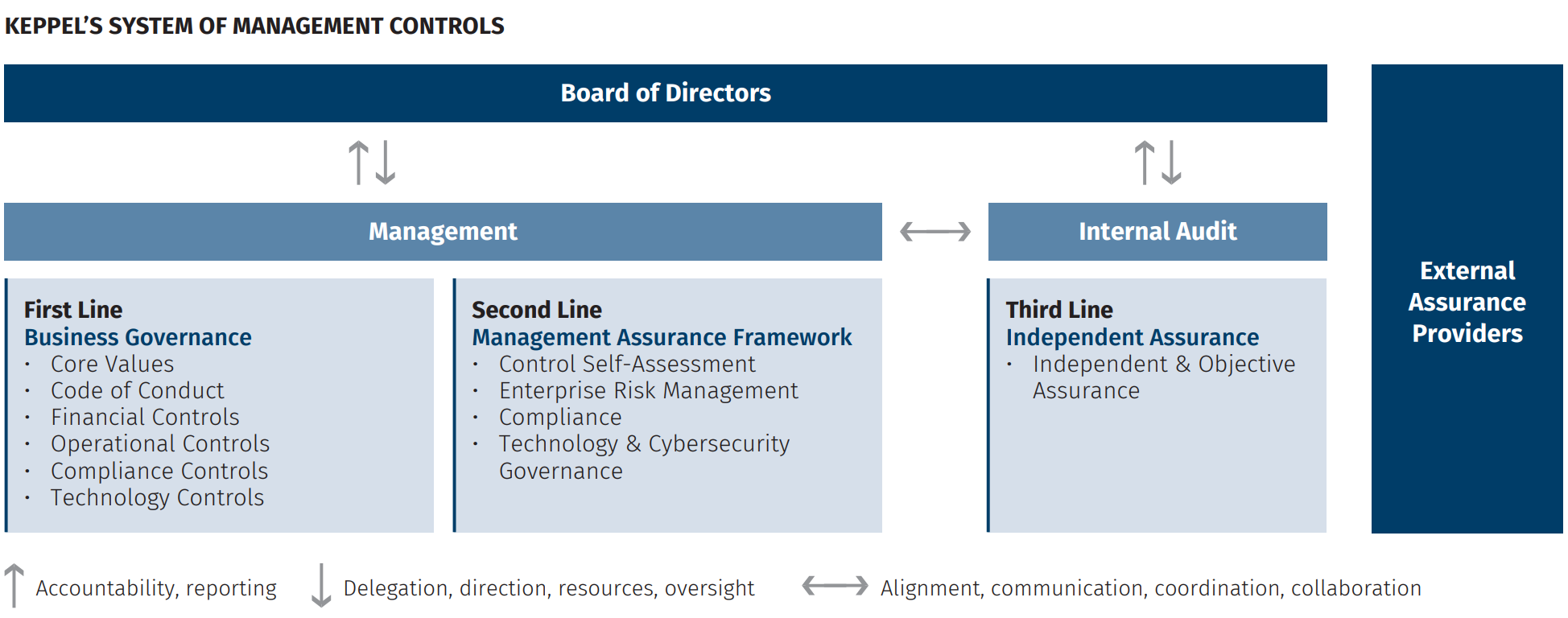
We are guided by our core values and Code of Conduct. We will do business the right way and comply with all applicable laws and regulations in whichever countries we operate. We strive to deliver outstanding performance, whilst maintaining the highest ethical standards in line with applicable laws and regulations.
We are clear with our strong tone on compliance, which is consistently emphasised by the Board and management and across Keppel. We do not tolerate fraud, bribery, corruption or any violations of laws and regulations.
Our Compliance Framework is structured to align with our business needs and it incorporates appropriate control systems to identify, address, and prevent compliance gaps. The Framework is anchored on six pillars: culture; policies and procedures; training and communications; key processes; risk assessment, review and monitoring; and resources.
Keppel adopts a balanced approach to risk management, optimising returns while safeguarding long-term business sustainability and stakeholder value. Managing risks effectively is an integral part of how we develop and execute our business strategies. It is grounded in the belief that a balanced risk-reward methodology is the optimal approach. This applies to all aspects of Keppel’s business, and in particular, our commitment to environmental, social and governance issues, and our commitment to deliver long-term value to our stakeholders.
Having a risk-centric culture is key to effective risk management. The key elements of Keppel's risk-centric culture are: leadership and governance; training, competency and communications; transparency; framework; ownership and accountability; and process and methods.
Keppel is committed to building a resilient, responsible, and diversified supply chain, including through integrating ESG criteria in the selection, monitoring and assessment of suppliers. We also actively engage our suppliers to encourage the adoption of sustainable and responsible business practices, minimise negative ESG impacts and manage risks across our supply chains.
We contract Singapore and overseas suppliers for our various business operations. We recognise the importance of responsible supply chain management and sustainable procurement in managing risks, building operational resilience, minimising financial risk, ensuring business continuity, as well as contributing to sustainable development.
Key priorities of our supply chain management strategy include evaluating the track record of suppliers, aligning suppliers to the ESG criteria and ethical practices set out in Keppel’s Supplier Code of Conduct, and ensuring product quality and cost optimisation.
We adhere to local content requirements, where applicable, and are committed to strengthening our base of local suppliers in countries where we operate. In doing so, we support economic growth, generate employment opportunities, build capacities of the workforce in these countries, while potentially reducing carbon emissions related to the transportation of goods and services.
Our tracking of Keppel's Scope 3 carbon emissions includes emissions generated by our supply chain, and we are working with our suppliers and portfolio of investments to improve energy efficiency and reduce emissions, where possible.
Significant suppliers are suppliers that have significant business relevance to Keppel, or have substantial risks of negative ESG impacts, or a combination of both. Keppel assesses the significance of suppliers based on ESG considerations, cumulative order value and volume, single order value and volume, as well as business criteria such as component criticality and substitutability of products or services. Identifying significant suppliers enables us to better focus our efforts on improving ESG practices and performance in our supply chain.
All suppliers are qualified in accordance with our requisition and purchasing policies, and screened based on business relevance as well as ESG criteria including business conduct, human rights, health and safety, labour practices and environmental management and performance, as well as cybersecurity requirements. Suppliers with better ESG performance or who meet the Green Procurement Guidelines are preferred in supplier selection and contract awarding. In assessing the sustainability risks of potential suppliers, we review suppliers’ industry reputations, track records, financial performance, security practices, and certifications, with a preference for suppliers with certifications for ISO 9001 Quality Management System, ISO 14001 Environmental Management System, OHSAS 18001 Occupational Health and Safety assessment series or ISO 45001 Occupational Health and Safety Management System or the equivalent.
As part of the supplier selection procedure, all new suppliers that provide Keppel with products and services valued at $200,000 or more per contract or over cumulative purchase orders in the prior calendar year are expected to sign and abide by the Keppel Supplier Code of Conduct, which is publicly available online.
The assessment of supplier risks and conduct of due diligence measures undertaken by Keppel are ongoing processes which take place throughout the life cycle of the buyer-supplier relationship. This includes desk assessment, on-site internal audits as well as external audits as part of the ISO 14001 assessment framework. We have engaged a third-party supply chain risk management platform to facilitate the screening of new and existing suppliers and conduct supplier desk assessments.
1 This refers to suppliers who provide goods and services or works amounting to $10,000 or more per Purchase Order, with certain exclusions such as procurement related to general administration.
2 The SCOC is found on Keppel’s website. It is also available in Chinese, Vietnamese and Bahasa Indonesia languages.
3 The Policy supplements Keppel’s technology policies and procedures on the engagement and management of technology outsourcing risks and details the requirements for engaging vendors for all technology-related products.