


Copy Link


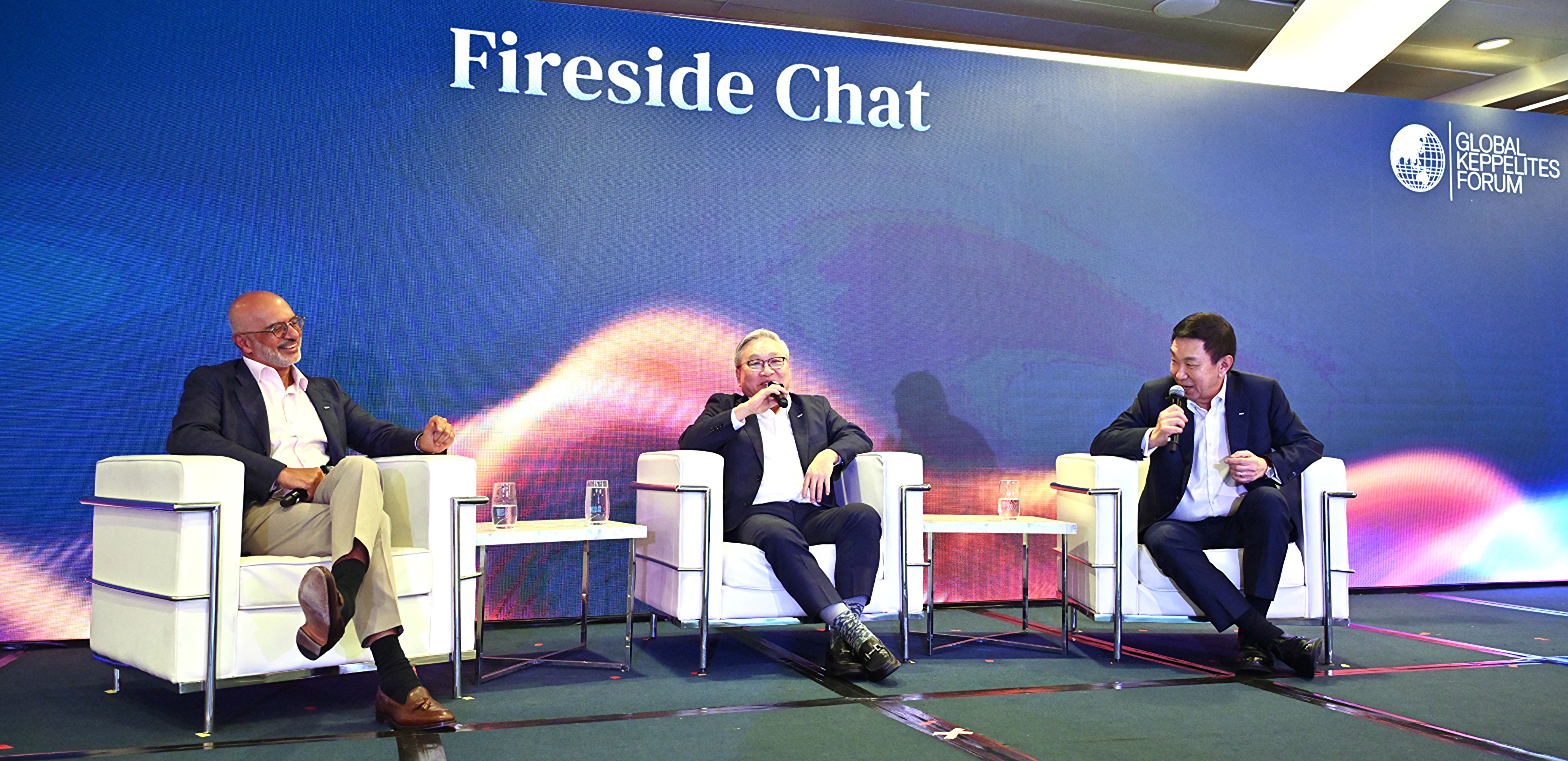
Keppel’s annual townhall, the Global Keppelites Forum, was held in February 2026, bringing together close to 1,000 Keppelites, with about 250 attending in person at the Suntec Singapore Convention & Exhibition Centre and participants from over 15 countries joining via webcast.
A key highlight of this year’s forum was a fireside chat with Keppel Chairman Mr Danny Teoh and Deputy Chairman Mr Piyush Gupta, which was moderated by CEO and Executive Director Mr Loh Chin Hua. The discussion covered Keppel’s progress and the priorities ahead as it continues to scale as a global asset manager and operator.
As Mr Teoh will retire as Chairman on 17 April 2026 while Mr Gupta will take over as Chairman on the same day, Keppelites also took the opportunity to pay tribute to Mr Teoh for his more than 15 years of dedicated service on Keppel’s Board, including the last five years as Chairman.
Below are some highlights from the fireside chat.
Chin Hua: Danny, you have been on the board of Keppel for more than 15 years. When you look back, what stands out most for you?
Danny: One of the highlights was the merger between Keppel Offshore & Marine and Sembcorp Marine. I remember asking at one of my first Keppel strategy meetings, whether it made sense for the number one and number two global players in rig building to come together. There was some laughter in the room from a few of the senior personnel, explaining that many attempts had been made in the past.
Chin Hua and I worked through the challenging task of getting that across the finish line. That was critical to the journey to where we are today. With the offshore and marine business in the portfolio, it was very difficult for Keppel to reposition itself for the future. That step was therefore pivotal in transforming Keppel from a conglomerate best known for rig building into the global asset manager and operator it is today.
Chin Hua: You have seen Keppel transform from the ‘old Keppel’ to the New Keppel. What do you observe as the biggest shifts in culture and people?
Danny: When I joined in 2010, Keppel was already entrepreneurial and opportunistic, always looking for deals. At the time, Keppel was a diversified conglomerate. That was the model then, and it worked tremendously well in those days.
But the world has changed, and so has Keppel. One of Keppel’s enduring strengths is its ability to adapt quickly, and the transformation over the last three years was no mean feat.
There is one stark difference today: Keppel is now one company. In the past, things were organised more around individual businesses, and decision‑making tended to sit higher up. Over time, that has changed. The move to a single P&L was an important step, because it aligned everyone around a common outcome. Culture used to be shaped more strongly at the business level; today, there is much greater consistency and a stronger sense of a shared direction across the Company.
Culture is always a work in progress. We still have more to do, but we have progressed a long way.
Chin Hua: Piyush, you joined the Board in July last year. You knew Keppel from the outside, and now you have a ring-side seat. What has surprised you most?
Piyush: Let me start by saying how excited I am to take on the role of Chairman. Keppel has long had a strong reputation for change, and from the outside, what stood out to me was the transformation that was underway once again. Having had the opportunity to see the organisation more closely, I have been very impressed by the progress made. Many people are familiar with transformation stories in different sectors, including banking. What is distinctive about Keppel is the breadth and complexity of the change it is undertaking.
In banking, transformation is often about reimagining how you operate within the same underlying business. Keppel’s transformation goes further – it involves reshaping the underlying business itself, moving from an industrial conglomerate to an asset manager and operator. That is a fundamentally different kind of shift.
This type of transformation is very hard. It is multi-dimensional: you rethink the business model, exit some businesses and monetise certain assets, and you change the mindset internally. Culture cannot be changed by emails or slogans. You need real programmes of change.
When I look at Keppel, I am impressed with the segment strategy, the internal change programmes, and the progress made in two to three short years. It is much more than what I saw from the outside.
Chin Hua: As you became familiar with Keppel from the inside out, you have said that our strategy resonates with you. What gives you that confidence?
Piyush: First, the model aligns with long‑term megatrends. Geopolitics are unpredictable. AI and technology will be disruptive. But some fundamentals are clear: people will continue to need to live, work, move and consume. As long as we are in real asset businesses that serve everyday needs, there is inherent longevity.
Second, real asset businesses tend to be balance‑sheet heavy and utility‑like, which can limit returns. The model works only if you stay in these businesses and drive higher returns through capital efficiency, including bringing in third-party capital. The intuition behind Keppel’s model makes sense, and the underlying businesses make sense.
Third, in a world where many companies are becoming asset managers, differentiation comes from operating capability. What the market will value is Keppel’s ability and expertise to run operations.
Question from the audience: Transformation takes time. As leaders, how do you decide what to be patient about, and what to be impatient about?
Piyush: That is one of the hardest questions for any leader – the trade-off between short term and long term. There is no science to it. You need a broad sense of megatrends, a sound view of your positioning, and then you back your judgement. Over time, if the numbers do not come through, you have to ask whether something is fundamentally flawed. How long do you wait? You weigh the size of the prize, how critical it is to your future, and what walking away does to your overall narrative. Many factors matter when one must make the call.
Danny: When we landed on the strategy of being an asset manager and operator, the comfort I had was that asset management was not new to Keppel. We have been doing it for many years. The core operations – infrastructure, real estate and connectivity – were already in place. We were not starting from scratch. The biggest challenge was culture: getting everybody tuned to the strategy. That is always the most difficult part, and it is not just about the leadership team. It has to reach the whole organisation.
Chin Hua: A question from the online audience – what values and principles should Keppelites continue to uphold?
Danny: Our core values – Agile, Can Do, Trusted – serve Keppel very well. Trust is fundamental – the trust with investors, customers and stakeholders. Being Agile and having the Can Do spirit are also critical. When we face challenges, such as in complex engineering projects, we find ways to deal with the issues and move forward.
Piyush: The spirit of empowerment and entrepreneurship is clear at Keppel. Being willing to take risks is a very important part of Keppel’s DNA, and we must preserve that. At the same time, what we have gained over the last few years is equally valuable – we have built credibility with the market through alignment and consistency. There is a consistent story that comes through every quarter, and the market believes in it. That consistency has tremendous power.
Chin Hua: Looking ahead, what do you hope to see in 2026, and what will define Keppel’s progress?
Piyush: I am fully bought into what Keppel’s agenda is and what we need to do. Looking ahead, Keppel will need to scale and grow the asset management platform. Fundraising conditions are not easy, but traction and momentum matter, and we have to keep scaling toward the target. At the same time, continued monetisation is important. We have been clear that a portion of monetisation will be returned to shareholders, and we need to demonstrate progress.
The way companies operate is also changing fundamentally. With developments like AI and the evolving nature of work, the pace of change is very real. We have to keep embracing this shift.
If we give ourselves a ten-year horizon, there is no reason Keppel cannot be as large as the leading global asset management platforms. We are in the right place. If we execute well, the opportunities are there.
Chin Hua: Any closing thoughts, Danny?
Danny: It has been a pleasure serving Keppelites. These five years as Chairman have been exciting, and it is not often you get to be part of a transformation of this scale. Over the 15 years, I have built many friendships, and I hope we stay in touch. Thank you for the support over the years. It has truly been a great journey.
