


Copy Link


How cooling and Energy-as-a-Service are reshaping urban infrastructure and the environment
Cities rely on essential systems – energy, water and waste – that must operate reliably across economic cycles. As urban populations grow and temperatures rise, the challenge is no longer simply to expand capacity, but to make these systems more efficient, resilient and adaptable over time.
Cooling is fast becoming a critical pressure point. In tropical and rapidly urbanising cities, it is one of the largest drivers of electricity demand in buildings, placing increasing strain on urban energy systems and power grids. It is also where the energy transition becomes most tangible – not just in how buildings are designed, but in how they are powered, cooled and operated more efficiently and reliably.
This is where Keppel’s Energy-as-a-Service (EaaS) model comes into focus. Rather than treating infrastructure as a one-off capital investment, EaaS delivers integrated energy solutions as ongoing, subscription-based services anchored on performance outcomes. These include cooling, smart energy management, distributed solar photovoltaic, as well as thermal and battery energy systems.
By reducing heavy upfront capital requirements, embedding efficiency into day-to-day operations, and aligning incentives around long-term outcomes, the model shifts the focus from asset ownership to lifecycle performance, with operational efficiency outsourced to the service provider.
Cooling illustrates how this model can scale. At the level of large commercial districts, district cooling systems aggregate demand across multiple developments, enabling more efficient load management and reducing overall energy consumption. Such systems can achieve significant efficiency improvement of up to 40% compared with conventional in-building chilled water systems, while enhancing reliability and smoothing demand peaks and load pressures.
With more than two decades of diversified experience across commercial and industrial sectors – spanning business parks, industrial facilities, mixed-use developments, commercial offices, hotels and malls, Keppel’s aggregation model and system-level expertise are already being applied to other high-load, mission-critical infrastructure, including wafer fabrication facilities and data centres – where efficiency, reliability and scalability are critical.
In Singapore, Keppel is linking the existing Fusionopolis 2A chilled water plant with its Biopolis and Mediapolis district cooling system plants into a large-scale chilled water network, forming Singapore’s first fully integrated and largest chilled-water thermal grid. With a combined capacity exceeding 70,000 refrigeration tonnes, the system will support more than 25 developments – demonstrating how infrastructure can be optimised across entire precincts rather than within individual buildings, while enhancing overall system resilience.
The need for more efficient and reliable cooling extends beyond commercial and industrial districts to residential developments and healthcare facilities. In Tengah, Singapore’s first and largest smart and sustainable HDB town, Keppel has been awarded the contract to design, build, own and operate centralised cooling systems serving multiple residential projects. Covering thousands of households, these systems demonstrate how cooling can be delivered more efficiently at scale while enhancing comfort and reducing lifecycle costs for residents.
Keppel is also exploring extending the service coverage of its District Cooling System plant in the Jurong Lake District to support a broader mix of developments across precincts, including commercial, residential and institutional uses, alongside potential integration with healthcare facilities such as Ng Teng Fong General Hospital and Jurong Community Hospital. This reflects how district-level infrastructure can be optimised to serve both township-scale developments and mission-critical environments, enhancing energy efficiency, operational reliability and overall system resilience.
To complement district systems, Keppel also provides retail cooling solutions for individual buildings and assets, extending the benefits of centralised systems beyond defined network areas. These solutions can deliver lifecycle cost savings of up to about 20% while maintaining high operational efficiency, making them relevant for a wide range of existing cooling assets undergoing decarbonisation and asset rejuvenation.
Beyond Singapore, Keppel is also deploying EaaS solutions across markets including China, India, Thailand, the Philippines and Vietnam, supporting customers in their transition towards more efficient and lower-carbon energy systems. This reflects a broader opportunity to scale integrated cooling and energy solutions across rapidly urbanising regions where demand growth and climate pressures are most acute.
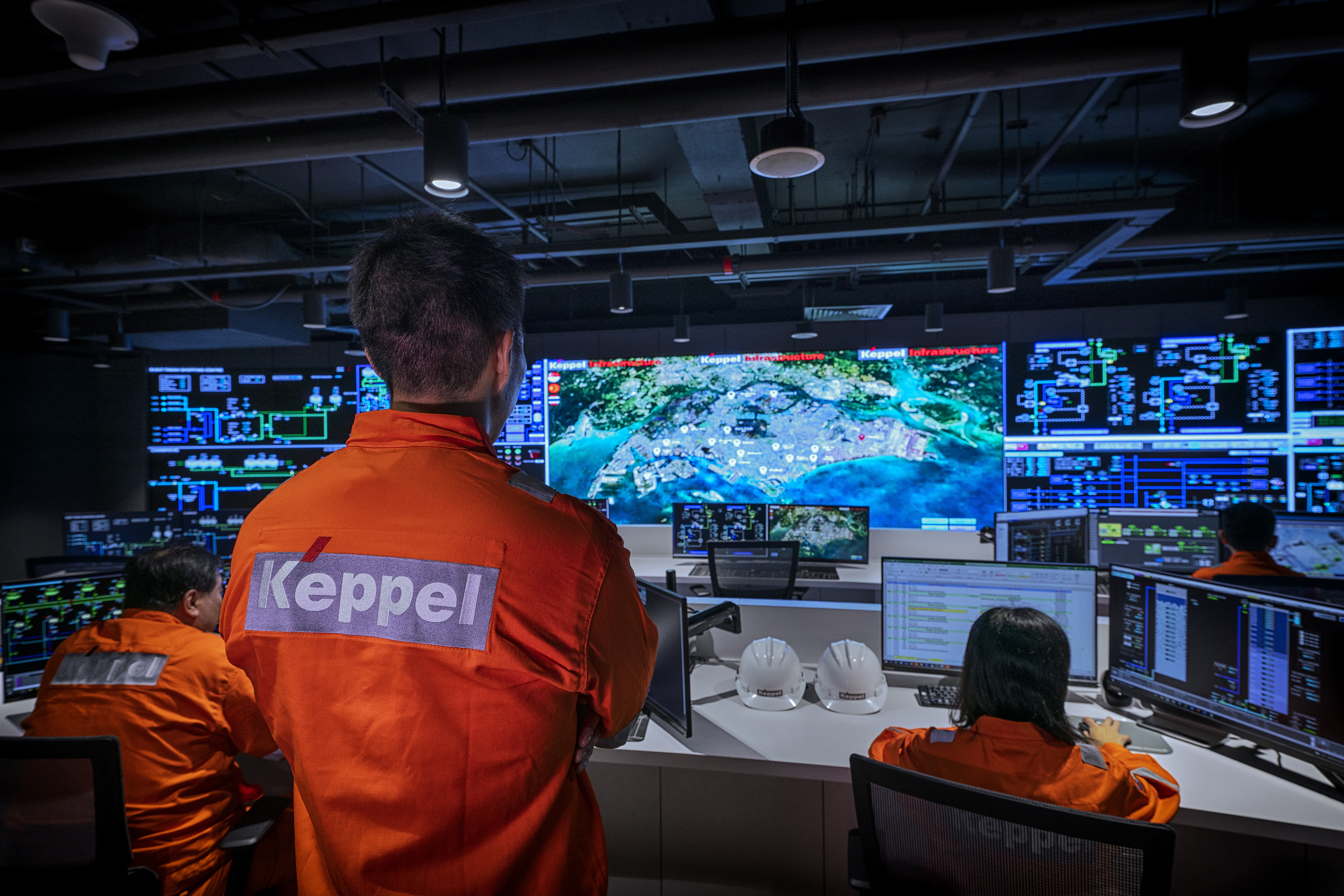
Underpinning these solutions is Keppel’s Operations Nerve Centre (ONC) and Infrastructure Intelligence (II) capabilities, which leverage advanced data analytics, agentic AI and machine learning to enable remote, 24/7 monitoring and optimisation across its portfolio. By integrating real-time data with predictive insights, the platform enhances system performance, anticipates maintenance needs and enables continuous optimisation at both asset and network levels.
Looking ahead, Keppel is also exploring innovative concepts such as smart modular cooling systems – pre-engineered and prefabricated units that can be deployed more rapidly and flexibly across different sectors. When combined with digital optimisation and scalable service models, these solutions have the potential to accelerate deployment while reducing project risks and improving lifecycle outcomes.
As cities become denser and climate pressures intensify, cooling is becoming a defining challenge of urban infrastructure. Meeting this challenge will require systems that are not only efficient, but also resilient, scalable and continuously optimised.
Performance-based, service-led models such as EaaS are increasingly set to become the new norm – enabling cities to meet rising demand while strengthening energy security and advancing decarbonisation goals. Operators that combine engineering expertise, digital capabilities and proven operating experience will play a central role in shaping more resilient and sustainable urban environments.
