


Copy Link


This is a reproduction of an interview originally published on 10 June 2025 in "I by IMD", a quarterly magazine and daily knowledge hub produced by IMD Business School, as part of its CEO Dialogue Series.
Mr Loh Chin Hua, CEO of Keppel, tells Professor Jean François Manzoni, Professor of Leadership, Organizational Development and Corporate Governance at IMD, how bold restructuring, strategic discipline, and a long-term vision transformed an industrial conglomerate into a global asset manager.
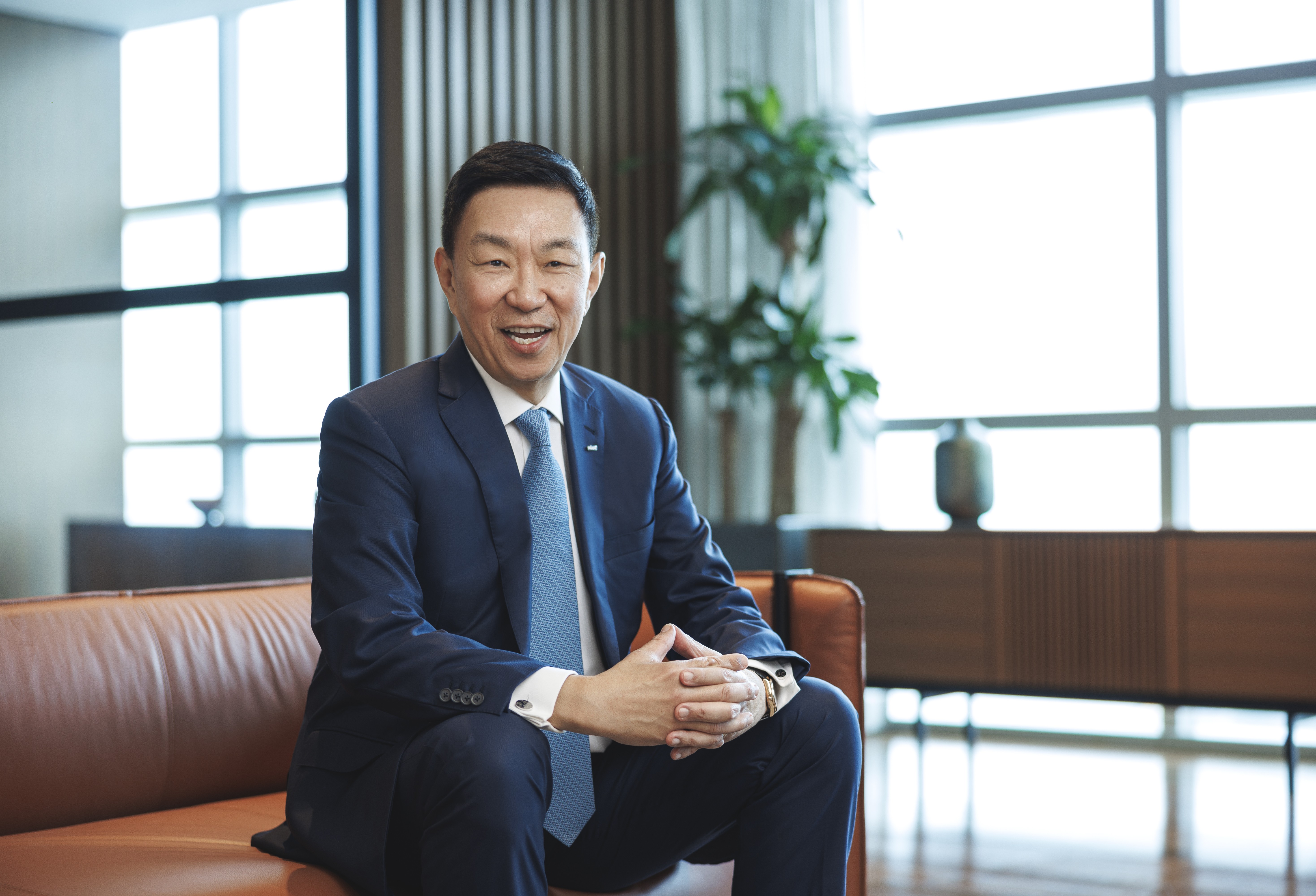
When Loh Chin Hua became CEO of Keppel in 2014, the company epitomised a not-uncommon Asian conglomerate model: diversified across sectors, asset-heavy, and driven by project-based revenue. Its operations – offshore rig construction, shipyards, infrastructure, real estate, and telecommunications – had long contributed to Singapore’s economic development.
But by the mid-2010s, investor expectations had shifted. Markets increasingly favoured focused companies with higher returns and scalable recurring income. Keppel’s complexity and exposure to cyclical industries meant its valuation lagged behind the sum of its parts.
Over the next decade, Loh led one of the region’s most ambitious corporate reinventions – transforming Keppel into a global alternative asset manager and operator with deep expertise in sustainable urbanisation and digitalisation. This was more than a portfolio shift; it was a strategic and cultural redefinition.
From conglomerate discount to strategic clarity
Keppel’s diverse activities had served it well. But by 2018, the model was under strain.
“We’d been very successful as a conglomerate for many decades, but the market was changing,” Loh explained. “Our recurring income was low, and we were not attracting the kind of growth multiples that we wanted to see. To add insult to injury, the market was further penalising us through a conglomerate discount.”
“For all these reasons, we started to look at how we could transform ourselves into a company that would attract a better valuation,” he said. “And, of course, if the sum of the parts of your businesses is greater than your market capitalisation, there's always a danger you're inviting attention that is not necessarily desired.”
Loh launched a strategic review involving future leaders and the board. Three paths emerged: maintain the status quo, become an engineering firm, or pivot to asset management. Keppel chose the latter but combined it with its historical expertise.
“Unlike most asset managers, we are also very strong operators,” Loh said. “As a result, investors see us as quite a different animal compared with a typical general partner.”
Letting go of legacy
A defining moment came with the decision to divest Keppel’s offshore and marine (O&M) business, which was its original core.
“If you look back at the source of Keppel, we started from the shipyard,” reflected Loh. “This is the business that built up all our other businesses, so to spin it off or divest was a pretty tough decision.” Keppel recognised early that the 2015 oil downturn was structural and required a significant reduction of the cost base, achieved by right-sizing operations and divesting underperforming yards. The result: stronger performance.
In 2023, Keppel merged its O&M business with Sembcorp Marine, forming a new entity – Seatrium – with Keppel’s unit arguably emerging as the stronger partner. The transformation was more than financial. Loh and his team placed equal emphasis on morale and engagement, especially among employees facing uncertainty. “When the chips are down, it’s very important, as a leader, to provide some hope and to remember to shout out to them for all the good work they did. There were not many things to celebrate, but whatever small victory we had, we celebrated it very hard.”
You just have to believe that if you keep doing the right things and you keep moving the chains, as they say in American football, then eventually you will get there, and the market will change.
Freeing up capital, doubling down on focus
Monetising underused assets was another critical move. Loh’s team identified S$17.5bn ($13.3bn) on the balance sheet that Keppel no longer needed to own.
“These were not bad assets by any means,” Loh said. “But they may be better off with somebody else, for example, someone looking for a stable yield.”
Rather than fully exit, Keppel often retained operational roles, continuing to manage assets while transferring ownership to Real Estate Investment Trusts (REITs), private funds, or other third parties. This approach allows Keppel to maintain recurring income and operational oversight. Over S$7bn ($5.3bn) has already been monetised, with the company on track to reach its S$10-12bn ($7.6-9.1bn) target by 2026.
This shift supports Keppel’s asset-light model while deepening investor partnerships and preserving operational capabilities.
Tearing down silos
To support its new direction, Keppel reorganised its structure under Vision 2030, moving from vertical business units to three horizontal platforms focused on real estate, infrastructure, and connectivity. These are supported by integrated investment, operating and fund management functions.
Preparation began years earlier. “We started to work together across divisions, which was not natural for Keppel, being so siloed,” Loh said. “Then we privatised our subsidiaries to bring everything under one roof. It allowed us to deploy capital more strategically and manage our talent across the group. Finally, in 2023, we completed the integration.”
By January 2024, Keppel was operating as one integrated firm. “When we made the move, it wasn’t chaotic,” Loh said. “People embraced it because we had been preparing for some time, and the rationale was very clear. We had removed friction points, organisational and human, and we had the right people in place to lead.”
Among those leaders was Cindy Lim, now CEO of the infrastructure division. “She wasn’t necessarily the obvious candidate on paper,” Loh said, “but she had a willingness to take on challenges and consistently exceeded expectations. We saw potential, and we acted on it.”
Proving sustainability pays
Keppel’s reinvention has also been philosophical. Once viewed primarily as a risk mitigation issue, sustainability is now seen as a commercial opportunity.
“It’s about doing more with less,” Loh said. Take Keppel Bay Tower, the company’s headquarters, which was retrofitted into a net-zero energy smart building. It became Singapore’s first commercial development to earn the BCA Green Mark Platinum Zero Energy certification, boosting net operating income by 31% and creating S$150m ($114m) in asset value.
That success underpins a new line of business: helping clients refit and future-proof real estate for a lower-carbon future. “You can be sustainable, but at the same time, it doesn’t create a lower return for you,” Loh stressed. “That’s important for people to understand.”
Navigating uncertainty with vigilance
This sustainability mindset mirrors Keppel’s geopolitical posture: anchored, alert, and agile. Operating in over 20 countries, the company must continuously assess shifting global currents. Loh, who began his career at Singapore’s sovereign wealth fund GIC and worked across global hubs, brings a critical perspective.
He noted that while Keppel has benefitted from global integration, both the company and Singapore must remain vigilant amid rising tensions. “We can’t take anything for granted. It’s important that we are able to keep evolving and making sure we remain relevant,” he said.
Leading through crisis and into the future
Undoubtedly, one of Loh’s defining qualities is his composure in crisis. In 2020, as Keppel’s stock hit record lows, oil prices collapsed and a major shareholder withdrew a takeover bid, he managed to stay – and keep Keppelites – focused.
“You just have to believe that if you keep doing the right things and you keep moving the chains, as they say in American football, then eventually you will get there and the market will change,” he said. “Of course, it's easy to get frustrated if you allow yourself to think things like: ‘I'm doing all these things, but the market doesn’t value them –how unfair!’ But better to stay focused on our own actions and trust the process.”
In his 12th year as Keppel’s CEO, Loh remains curious, engaged, and energised. “I remain very grateful to be given this opportunity to be in this great country, leading this amazing organisation called Keppel at such an exciting time in its history, and working with such passionate and committed colleagues.” Commenting on his ongoing curiosity, he added: “I believe I'm a good student in life. And I don’t mean a student in the traditional sense in the classroom. I continue to observe and learn quite a bit when I visit people and places.”
Keppel’s reinvention continues. But the direction is clear, and the foundation is strong.
